Information Watchdog Investigates MOD for Withholding British Army Agent’s Secret Files Following Victim’s Complaint
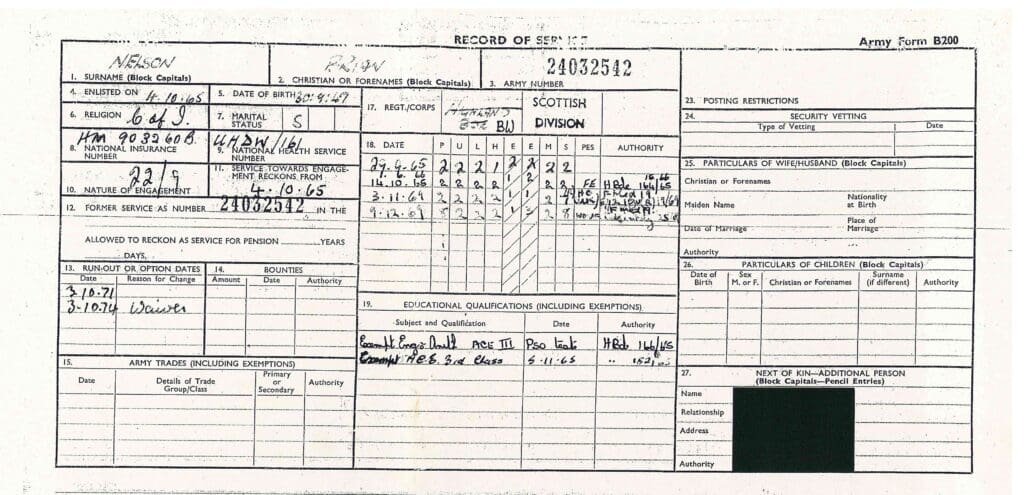
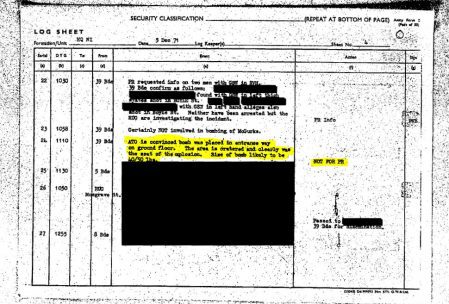
The Information Commissioner’s Office (ICO) is investigating why Britain’s Ministry of Defence (MOD) is withholding a secret file retained by the government department relating to Brian Nelson, the British Army’s most notorious agent it embedded within a Loyalist death squad.
Belfast charity, Paper Trail Legacy Archive Research, acting on behalf of Elaine McNally whose father, Gerald Higgins, was kidnapped and tortured near to death by Nelson and an Ulster Defence Association (UDA) gang, lodged a formal complaint with the Information Commissioner’s Office. The ICO has told the Higgins family it is now investigating.
The complaint centres on National Archives file DEFE 24/3537 [link].
This is a MOD file regarding British intelligence, the aftercare of its agents, and Nelson, dating from 1992 to 1994. Paper Trail submitted a Freedom of Information request in July 2025 on behalf of a daughter of Gerald Higgins, a partially-sighted (medically blind) man who was kidnapped, tortured, and nearly murdered by Brian Nelson in March 1973.
Mr. Higgins never fully recovered and died seven years later. His family believes he died prematurely as a result of his torture at the hands of the British Army agent..
 Listen to the Paper Trail Pro Podcast: Brian Nelson - Diminishing Responsibility?
The MOD refused the request in September 2025, citing exemptions relating to personal data, National Security, defence capability, and the safety of individuals. An Internal Review, requested by Paper Trail on the same day as the refusal, was not concluded for seven months — until April 2026 — leaving the victim's family waiting still longer for answers. Paper Trail then escalated a complaint to the ICO, and the ICO has informed them this month that the complaint is eligible for investigation..
A Pattern of State Concealment
The British Army embedded Brian Nelson in the Ulster Defence Association (UDA). His activities — including his role in directing Loyalist death squads — were the subject of the De Silva Review, commissioned in 2011, into the murder of solicitor Patrick Finucane.
Despite being presented to the public as a comprehensive account of the British Army agent's activities, the Review failed to examine Nelson's earliest paramilitary career, including his arrest in 1973, his debriefing by British military intelligence following the kidnap and torture of Gerald Higgins, and his employment by the British Security Forces.
This means that Gerald Higgins’ family and the many other families impacted by the British Army agent’s violence have never received a full account of how the British state employed, protected, and shielded Nelson from proper justice.
“An insult to victims”
Mr. Higgins’ daughter, Elaine McNally said:
“We are searching for the answers to the questions we have about the kidnap and torture of our father, Gerald Higgins, by British Army agent Brian Nelson. Those answers lie within archives held by the British state. Many of those files remain CLOSED. In the past, we have used FOIA to request files from the MOD, PSNI, and Public Prosecution Service relating directly to Nelson, but we have been met with denial and delay.”
“This MOD file concerns the ‘aftercare’ of the British Army agent following his murderous career on behalf of the British state and his violation against my father. MOD has denied us any access to this file and wants it to remain closed, even though Brian Nelson is dead and much of the information about his deadly career should already be in the public domain - most recently acknowledged by the Chief Constable to the Policing Board this year.”
“Now, the Information Commissioner Officer will investigate our complaint against this disgraceful MOD decision and its attempt to bury the truth. It will no doubt take time and may result in an appeal before an independent tribunal. My family will confront each obstacle to information recovery that the British state raises against us until we have a proper measure of truth, justice, and acknowledgement.”
Continued below...


Ciarán MacAirt, Project Manager at Paper Trail, said:
"It is an utter disgrace that in 2026, a daughter of a man who was kidnapped and tortured by a British Army agent is forced to use Freedom of Information legislation over half a century later simply to access files that ought to have been disclosed through official investigations decades ago. Nelson is dead. The MOD's refusal to release even a redacted version of this file and its seven-month delay for an internal review are symptomatic of an institution that has learned nothing about transparency and everything about cover-up and self-protection.
The British Ministry of Defence continues to abuse the Freedom of Information Act and Ms. McNally’s basic human rights. It also insults hundreds of other victims and survivors of this British Army agent’s death squad."
Christopher Stanley, Relatives for Justice, said:
“RFJ has been assisting Elaine McNally and her family regarding the kidnap and torture of Gerald Higgins. Elaine has used the FOIA regime to try and gain access to information about her father and the role of Brian Neslon in his kidnap and torture.
To date, she has been met with refusals and the application of exemptions. These have included FOIA requests to the PSNI, MOD and PPS. Paper Trail has identified a possibly important MOD file about Brian Nelson and his ‘aftercare’ following his conviction and imprisonment regarding offences against Gerald Higgins. Whether this CLOSED file – we assume one of many – was made available to the De Silva Review is not known.
What is known is that the identity of Brian Nelson is in the public domain, that Brian Nelson is dead, and that this extensive 300-page file has been reviewed. We see no reason for the application of the FOIA exemptions relied upon by the MOD. What we do see is a denial of truth – again – for a family and the reliance on a ‘not fit for purpose’ information-recovery regime.”